 Ninety-eight women, all emerging global leaders in “high-tech” from the Middle East, Central Asia, and Africa, crowded into a room at LinkedIn in Sunnyvale, California for TechWomen Impact Day.
These women had never been to the United States before and their excitement was contagious. Their eyes sparkled and each of them had a bigger smile than the last. They were eager to learn how to have greater impact when returning to their countries.
The Leadership Style Center team was invited to open Impact Day, with each of the three of us presenting a snippet of our specialty. Check Karen Anderson Peters’ October 20th post to read more about TechWomen and the conference itself.
The foundation of body language
For my Visual Presence segment, I focused on two important aspects of body language: posture and gestures. Here I’d like to offer you some information and a few tips on posture, the foundation of body language.
Good posture sets the tone for how you are received. Whether you are entering a room, standing to talk with others, or sitting at a meeting, it influences whether others perceive you as worthy of being listened to.
Also, a joint study by the USC Marshall School of Business and J.L. Rotman School of Management at the University of Toronto found that good posture enables a person to have more energy and to tolerate more stress.
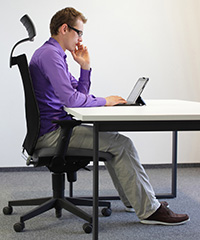
Conversely, bad posture suggests defeat—that you lack confidence or have low self-esteem. They noted that people with poor posture at work report low energy levels, leading to lethargy and reduced productivity. They also found that the greatest potential challenge to posture during this age of technology is sitting and working at a computer.
Good posture is standing and sitting tall and proud. To determine if you have good posture, take the mirror test. Check your side view—standing and sitting—in front of a full-length mirror.

Good standing posture
- Stand with your feet the same distance apart as your hips.
- Bear your weight primarily on the balls of your feet with your knees slightly bent.
- Let your arms hang down naturally at your sides.
- Stretch your body up, lengthening your neck while keeping your chin level and your earlobes in line with your shoulders.
- Expand your chest, pull your stomach in, and rotate your shoulders up and back.
Note: If you have been standing for a long time, shift your weight from your toes to your heels, or one foot to the other.
Good sitting posture
- Push your hips as far back as they can go in the chair.
- Adjust the backrest of your chair to support your low- and mid-back or use a back support.
- Place your feet flat on the floor, your knees level with, or slightly lower than, your hips. Use a footrest, if your feet don’t reach the floor.
- Stretch your body up, lengthening your neck while keeping your chin level.
- Expand your chest, pull your stomach in, and rotate your shoulders up and back.
- Keep your forearms parallel to the floor.
Note: Avoid sitting in the same position for a long time. Research indicates it is best to get up every hour and move around.
A few lifestyle tips for good posture
- Develop a regular program of exercise that helps tone your muscles to support good posture.
- Have your eyes examined—a vision problem can affect the way you carry yourself.
- Be conscious of your work area. Is your chair high enough to fit your desk? Do you need a footrest to keep pressure off your legs?
Good posture sends a message of self-assurance, authority, and energy. You both look, and are, more dynamic, more focused, and more purposeful.
I hope these tips help you attain your desired results, whether you present a project, lead a meeting, or conduct an employee review.

Leave a Reply